
Whole-Home Remodeling in Asheville, NC
Remodeling in Asheville and throughout Buncombe County.
Remodeling in Asheville
Remodeling an Asheville home means working inside what is already there — a floor plan drawn for a different way of living, framing that has moved since the day it went up, and mechanical systems sized for a smaller load than a modern kitchen puts on them. We start every remodel by understanding the house as built rather than as drawn, because on a renovation the drawings and the reality rarely agree.
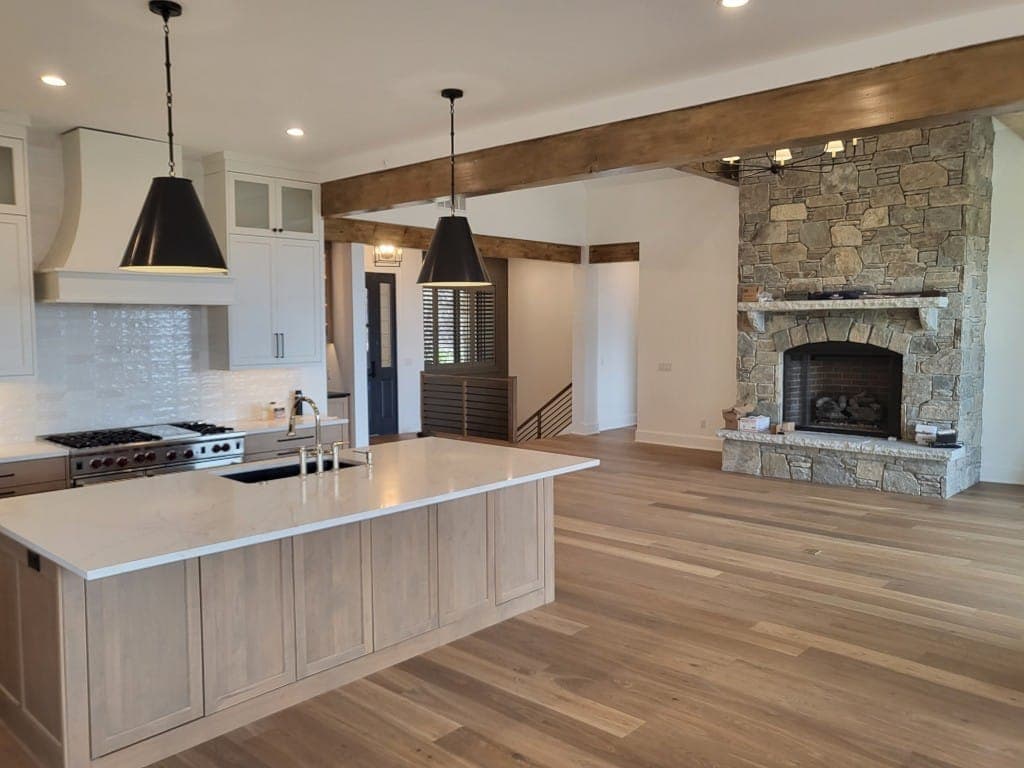
Blue Ridge Homes manages whole-home renovations across the city, from kitchen-and-bath scopes to full interior rebuilds that take a house back to the studs. Crown Point is representative: an existing home reworked around an open kitchen and a stone fireplace, with the structural changes that made that layout possible carried inside the same scope rather than handed off.
What a general contractor is actually for on a remodel is sequencing. Demolition exposes what an estimate could only guess at, and the schedule has to absorb that without stranding the trades behind it. We hold the schedule, we keep the budget conversation open, and we tell you what changed on the day it changes rather than at the end.

Building in Asheville: What the Site Decides
The Terrain Under the House
Asheville’s terrain shapes a remodel as much as it shapes new construction. Sloped lots mean crawl spaces and daylight basements rather than slabs, and that is usually where a renovation finds its surprises: moisture, undersized framing, and mechanical runs that were never meant to be permanent.
Permitting Inside the City
Permitting inside the city runs through the City of Asheville Development Services Department at the Permit Application Center on South Charlotte Street, which handles additions and remodels alongside new construction. Most projects over $40,000 require a permit, but cost is not the only trigger: any change to a load-bearing wall requires one regardless of value, and so does any plumbing, electrical, or HVAC work. Above $40,000 the work has to be done by a licensed general contractor.
The city doesn’t publish a review-time commitment. Asked directly in August 2026, Development Services put residential remodel plan review at one to two weeks — most often around a week — for a complete submission. An incomplete application restarts that clock, which is the largest variable and the one entirely within your control.
Historic Districts: Establish Which Kind
If the house is in a historic district, establish which kind before planning any exterior change, because the phrase covers two situations with opposite consequences. Asheville has four local historic districts — Montford, Albemarle Park, Biltmore Village, and St. Dunstan’s — along with roughly forty-seven individually designated local landmarks, and fourteen National Register historic districts on top of those.
Same words, opposite practical effect — one adds a review step, the other adds a funding option. Getting that wrong costs either a month of unnecessary process or a rejected permit.
| Local historic district | A Certificate of Appropriateness from the Historic Resources Commission is required before any exterior alteration, addition, or new construction, with major work heard at the commission’s monthly meeting. |
|---|---|
| What that certificate is | Design review only. It does not replace a building or zoning permit, and it is required whether or not a building permit is. |
| National Register district | A contributing structure in a National Register district is not subject to Historic Resources Commission design review at all; it is eligible for historic rehabilitation tax credits instead. |
Electrical Service on Older Stock
Electrical service is the other thing we assess early on Asheville’s older housing stock, and there is no typical amperage for a given vintage worth quoting. The code floor is a 100-amp service disconnect; actual size comes from a load calculation, and that calculation belongs before demolition rather than after. Induction cooking, a heat-pump water heater, or an EV charger each add substantial load, and a panel that was adequate for the house as built often isn’t for the house as remodeled. A service upgrade is a scoped line item when that is the case — not something discovered at rough-in.
Plaster, Lath, and Pricing Before Demolition
Plaster-and-lath walls change both the demolition method and what can realistically be done for insulation. None of this is a reason not to remodel. It is a reason to have the house priced honestly before demolition rather than discovered after.
Remodeling in Asheville: Common Questions
Do I have to move out during a whole-home remodel?
It depends on scope. A kitchen or bath remodel is usually livable if you can give up that one room. A down-to-the-studs interior renovation is not — the house loses water, power, and heat in stages. We will tell you which one you are signing up for before demolition starts, not after.
How long does a whole-home remodel in Asheville take?
Four to nine months, depending on the size of the house and how deep the remodel goes. A kitchen and two baths sits at the short end; taking a house down to studs and reworking the layout sits at the long end. Permitting sits in front of that, not inside it.
Can you work from my architect’s or designer’s drawings?
Yes, and we would rather be in the conversation before the drawings are final. A builder reading a plan early catches the details that get expensive later — a beam that has nowhere to land, a duct run with no chase, a window that cannot be flashed the way it is drawn.
What happens when you open a wall and find a problem?
We stop, document it, price it, and bring it to you before we proceed. Unknown conditions are the normal condition on a remodel, not an exception. A good estimate carries an allowance for them; what it cannot do is predict which one you will get.
Do you handle the permits?
Yes. Permitting, inspections, and scheduling the trades around them are part of construction management on every remodel we run — through the Permit Application Center for work inside the city limits. You are not the one calling the inspector, and you are not the one finding out that a load-bearing change needed a permit nobody pulled.
More about our work in Asheville: Remodeling across Western North Carolina, Custom Homes in Asheville, ICF Construction in Asheville, everything we build in Asheville.
Planning a Project in Asheville?
Tell us about the property and what you have in mind. We will tell you what it actually takes.