
What It Costs to Finish a Basement in Western NC
A lot of homes in western North Carolina are built into a hillside, which means a lot of homeowners are sitting on a basement that's either half-finished, used for storage, or just a damp concrete box under the stairs. Finishing that space is often the cheapest way to add real living area to a house, because the foundation, roof and footprint are already paid for. But "cheapest" is relative, and the range is wide. After 30 years and roughly 100 projects across Buncombe, Henderson and Haywood counties, here's how we think about what a basement finish actually costs here.
The short answer: a range, not a number
For a straightforward finish of a dry basement, meaning framing, insulation, drywall, flooring, lighting, outlets and a couple of doors, homeowners in our area should expect something in the range of roughly $35 to $70 per finished square foot. Add a full bathroom, a wet bar or kitchenette, a bedroom that needs a code-compliant egress window, or high-end finishes, and the project can climb to $80 to $120 per square foot or more.
Those numbers aren't a quote. The real figure comes from walking the space, and the factors below are what move a project from the bottom of the range to the top.
Water comes first
In the mountains, groundwater and runoff are the single biggest variable in a basement job. Houses cut into a slope often have one wall fully underground and one wall at grade, and the uphill side takes the water. If there's any sign of moisture, such as efflorescence on the block, a musty smell, or staining at the base of the walls, that has to be solved before a stud goes up.
Fixes range from simple to significant: regrading and extending downspouts, an interior drain tile and sump system, exterior waterproofing on the problem wall, or a dehumidifier sized for the space. Some homes need almost nothing; others need a meaningful share of the budget before finish work starts. Skipping this step is how people end up tearing out moldy drywall two years later.
Older housing stock adds surprises
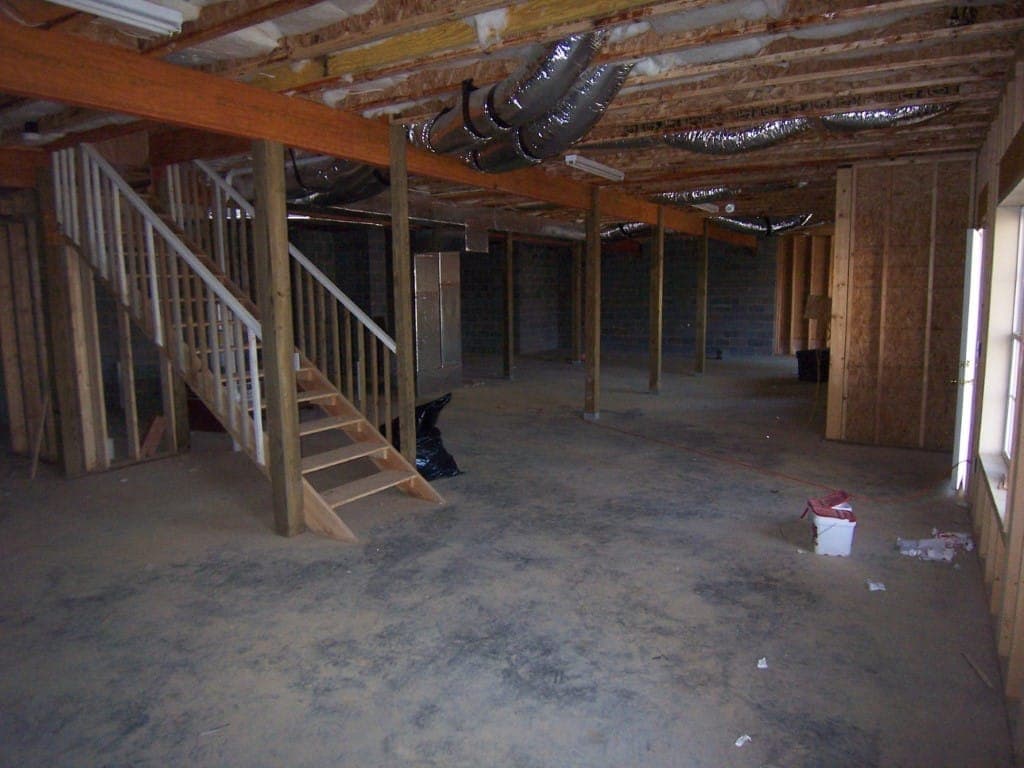
Much of the housing around Asheville, Hendersonville and Waynesville was built decades ago, and the basements show it. We regularly find low ceiling heights, ductwork and drain lines hanging below the joists, old wiring, undersized electrical panels, and stone or block foundation walls that aren't square.
Each of those has a cost. Rerouting ductwork or plumbing for headroom takes labor, a panel upgrade may be needed for new circuits, and uneven walls take longer to frame. In older homes we also plan for the possibility of lead paint or asbestos-containing materials around old pipes and flooring, which have to be handled properly if disturbed.
What drives the price up or down
Size and layout. One open room is the most efficient. Every interior wall, closet and door adds framing, drywall, trim and labor.
Bathrooms. A bathroom is usually the most expensive single room in a basement finish. If there's no existing rough-in, the plumber may need to cut the slab to tie into the drain line, or install an up-flush or ejector pump if the sewer line sits higher than the basement floor.
Bedrooms and egress. A room used as a bedroom needs an emergency escape opening. On a walkout basement that's often easy. On a fully below-grade wall, cutting a new egress window with a window well is a real line item.
HVAC. Extending existing ductwork is usually manageable. If the current system can't handle the added space, a ductless mini-split is a common and efficient option.
Flooring and finishes. Luxury vinyl plank over a proper subfloor or vapor barrier is popular for good reason; it handles moisture better than carpet or solid hardwood. Built-ins, a wet bar, upgraded trim and custom lighting all push the number up.
Labor and scheduling in WNC
Skilled trades in the region have been busy for years, especially since Hurricane Helene, and good electricians, plumbers and drywall crews book out. That affects schedules more than anything else. Homeowners should plan for some lead time.
Permits and inspections
Finishing a basement is almost always permitted work, because it involves framing, electrical, plumbing and mechanical changes. Which office handles it depends on your address. Inside city limits, the City of Asheville issues permits and does the inspections. Outside the city in Buncombe County, it's Buncombe County Permits and Inspections. In Henderson and Haywood counties, and in some incorporated towns, it's the county or town that covers the property. Fees and review times vary by jurisdiction and by the scope of the work, so it's worth confirming with that office or letting your contractor handle the application.
Unpermitted work tends to surface at resale, when finished square footage doesn't match county records.
Is it worth it?
For many families it is. A finished basement can become a guest suite, a home office, a playroom, or a place for a parent who wants to live close by but have some independence. Compared to building out, it usually costs less per square foot. If you need more space than the basement can give you, or the ceiling height just won't work, an addition may be the better answer, and it's worth comparing the two before deciding.
If you're weighing a basement finish as part of a larger project, you can see more about our remodeling work. For homeowners inside city limits, our page on remodeling in Asheville covers more of the local context.
Start with a walk-through
Every basement is different, and the honest way to price one is to look at it: check for moisture, measure the ceiling height, see where the plumbing runs and what the panel can handle. If you're thinking about finishing your basement, reach out to us for an estimate and we'll walk the space with you and give you a realistic picture of what it will take.
Ready to start your project?
Get in Touch